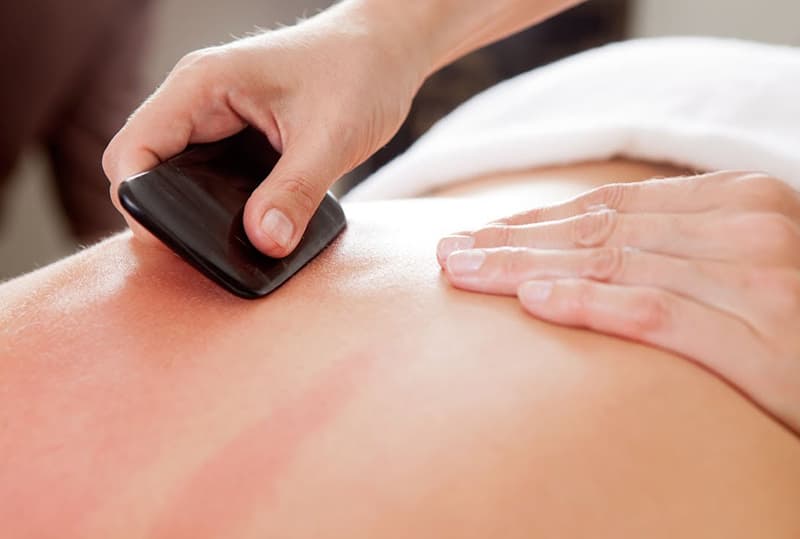
Gua Sha
"The body remembers what the mind forgets." — Unknown
What is Gua Sha Therapy?
Gua Sha is an ancient healing technique that began in China centuries ago. It is used in Asia by practitioners of Traditional Medicine, in both the clinical setting and in homes, but is little known in the West. "Gua" means to scrape or rub. "Sha" is a reddish, elevated patch of skin. It involves palpation and cutaneous stimulation where the skin is pressured, in strokes, by a round-edged instrument, such as a ceramic Chinese soup spoon, a well-worn coin, or, even honed animal bones, water buffalo horn, or jade. It results in the appearance of small red patches ("Sha'"), which are believed to remove blood stagnation, promoting normal circulation and metabolic processes. Gua Sha is valuable in the prevention and treatment of acute infectious illness, upper respiratory and digestive problems, and many other acute or chronic disorders.
How does Gua Sha Therapy work?
To apply Gua Sha, the practitioner first lubricates the skin area with oil and then places the Gua Sha instrument against the pre-oiled skin surface, presses down firmly, and then rubs the skin in downward strokes using moderate pressure or along the pathway of the acupuncture meridians, with each stroke about 4-6 inches long. There are two kinds of Gua Sha therapy. One is meridian scraping therapy which combines acupressure with cutaneous scraping. Another one is holographic scraping therapy, which involves scraping points on the body corresponding to organs in the body. This therapy has the special feature of scraping only a small area and taking a short time.
When fixed position cupping is used, a certain amount of bruising is expected at the cupping site. In traditional cupping, heated cups are used and the hot cups can also generate a similar stimulating effect like that of burning moxa wool in Moxibustion Therapy. However, with movement of the cups along the surface of the skin, it's somewhat like a gentler Gua Sha Therapy and some bruising is also expected. These bruises are usually painless, however, and disappear within a few days of treatment.
Gua Sha is applied primarily to the back, neck, shoulders, buttocks, and limbs of the body. Advanced practitioners may also raise "Sha" on the chest and abdomen. The color of "Sha" varies according to the severity of the patient's blood stasis-which may correlate with the nature, severity, and type of their disorder-appearing from a dark blue-black to a light pink, but is most often a shade of red. Because the scraping is on the oily skin, the patient will hardly feel pain - neither during nor after the treatment, and the skin will not be damaged. Since Gua Sha moves stuck Qi and blood, the patient typically experiences immediate relief from pain, stiffness, fever, chills, cough, nausea, and so on. The "Sha" bump should fade in 2-4 days. If it is very slow to fade, it indicates poor blood circulation and there may be more serious deficiency that will require additional treatments with a combination of acupuncture or acupressure in specific areas.
Gua Sha can be used up to three times weekly, and is most effective when used as a weekly treatment for chronic conditions.
There is an allied technique, BaSha. "Ba" means to pull out. It has a similar application to Gua Sha. Instead of scraping the skin with instruments, it is performed by gripping the skin, lifting it, and then flicking between the fingers until "Sha" appears. It is used more often on the tendons, at the center of the brow, or over specific acupuncture points.
What can be treated with Gua Sha Therapy?
Gua Sha is a simple while valuable method in the prevention and treatment of various disorders. It can stimulate the immune system, detoxify and de-acidify the body, promote blood circulation, regulate functions of organs, and remove blockades and pain.
In classical Chinese practice, Gua Sha is commonly used to treat and prevent acute conditions such as common cold or flu, asthma, bronchitis, as well as chronic problems involving pain and congestion of the Qi and blood. It has a very quick effect on pain from head, neck, shoulder, joint and back pain, fibromyalgia, sciatica and other nerve pain, migraine, PMS, osteoporosis, rheumatism. It also has obvious effects on various diseases caused by functional disharmony of the internal organs, such as digestive disorders, urinary, and gynecological disorders.